
What is the difference between debt consolidation and consumer proposal?
In summary:
- Debt consolidation is a loan granted by your financial institution to repay all or part of your debts.
- A consumer proposal is an agreement negotiated on your behalf by a Licensed Insolvency Trustee, usually for a reduced amount, to settle your debts. The interest rate on your credit cards, lines of credit, and personal loans is automatically reduced to 0%.
- The choice between the two depends on your financial situation: if you have a good credit score and stable income, consolidation is preferable as it won’t impact your credit report. A consumer proposal is a better solution if you’re unable to repay your debts or manage the interest charges associated with them.
What is a debt consolidation?
Debt consolidation is a loan granted to you by your financial institution to repay all or part of the debts you want to include in your consolidation.
It simplifies the management of your payments by grouping them into a single payment with a maximum repayment period of 5 years. However, you must meet the bank’s requirements to be eligible for consolidation, namely a good credit record, holding a stable job and having a debt ratio of less than 40%.
It is also important to know that the interest rate usually varies between 12% and 14%, which is higher than a regular loan. Thus, to save interest charges, it is important to consolidate only your debts that have a higher interest rate than your loan. Since you are paying 100% of your debts, there will be no negative impact on your credit report.
If consolidation is not possible, either because your financial institution refuses it or because the monthly payments do not meet your budget, the proposal then becomes an interesting alternative.
What is a consumer proposal?
The proposal is an agreement that a Licensed Insolvency Trustee negotiates on your behalf to repay your unsecured debts according to your financial capacity.
Since all interest on included debts is, by law, reduced to 0% and, in most cases, the offer is less than 100% of the total debts, the monthly payments will usually be much lower than that of a consolidation loan.
Like consolidation, the maximum duration of a proposal is 5 years and you can keep all the assets you want. However, your credit report will be negatively affected during the proposal and for 3 years after or 6 years after it was filed, whichever comes first. Therefore, if it takes you 5 years to pay off your proposal, it will be removed the following year.
Debt consolidation or consumer proposal: which one should you choose?
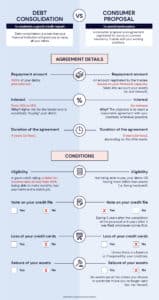
Here’s a quick overview of the differences between a consumer proposal and a debt consolidation:
| Consumer Proposal | Debt Consolidation |
| A Jean Fortin financial reorganization advisor negotiates with your current creditors for a monthly payment that fits your financial capacity, interest-free. | You fully repay selected debts through a bank loan with an interest rate typically ranging between 12% and 14%. |
| The sole eligibility criterion is to be unable to meet payments on personal debts OR to have more debts than assets. | Eligibility for a consolidation loan requires a good credit history, a satisfactory debt-to-income ratio, and the ability to meet the monthly loan payment. |
| The proposal includes all your unsecured debts, ensuring you only have one monthly payment. | To ensure you don’t pay more interest than before consolidation, you should only consolidate debts with an interest rate higher than your consolidation loan (between 12% and 14%). |
| You retain all the assets you want to keep; you can surrender those you no longer want, and no cosigner (endorser) is required as it’s not a new loan. | You keep all your assets, but the lender may require collateral or a cosigner for some of them. You cannot surrender (without penalty) assets you no longer want. |
| The proposal is reported to the credit bureau, but it offers flexibility to pay off early and restore your credit faster, with lower monthly payments. | A consolidation loan isn’t explicitly indicated on the credit report, but creditors might consider it if you decide to take on more debt afterward. |
Whenever possible, debt consolidation should be prioritized. However, before moving forward with this solution, it’s crucial to ensure that:
- You only consolidate debts with a higher interest rate than your consolidation loan, and especially
- You’ll be able to honor the monthly consolidation loan payment. To determine the amount, you can use our loan calculator.
Navigating through the different options can be very confusing. We can help you see more clearly and to help you achieve a life without debts. In 24 hours, you will have the answers to your questions and a plan that we will put in place with you.
Do not hesitate to contact us toll-free at 1 877-Liberté or to make an appointment online.
When debt challenges become overwhelming, you don’t have to face them alone. Our advisors are ready to guide you (free, no-obligation consultation).
See also...
Debt Consolidation
Find out how to merge all your payments into one monthly installment and keep your credit score intact.
Financial Health Checkup
The perfect tool to get a quick picture of your financial situation.
True Story – Borrowing from one credit card to pay for another? Beware!
Borrowing from one credit card to pay for another ? Beware ! Get to know what are the solutions when your financial situation begins to slip.