
How to reduce your monthly expenses: practical tips and advice
In summary:
- Set up a budget to better understand where your money is going and identify expenses that can be reduced.
- Adopt better daily habits: review your subscriptions, plan your meals, and avoid impulse purchases.
- If your efforts are no longer enough to restore your financial situation, do not wait to seek professional advice.
The rising cost of living is prompting more Quebecers to reassess their spending habits. The Consumer Price Index (CPI) increased by 3.6% year-over-year in May 2026 and a total of approximately 22% increase since 2020.
Whether your goal is to better balance your budget, increase your savings capacity, pay off debt more quickly, or achieve a personal goal such as purchasing a home, small changes can have a significant impact on your finances.
At Jean Fortin & Associés, we meet with thousands of people every year who are looking for solutions to regain control of their finances. One reality we see time and again is that financial difficulties are generally not caused by a single bad decision, but rather by the accumulation of small expenses and unexpected events.
In this article, we share practical advice based on real-life situations experienced by our clients to help you reduce your monthly expenses and regain greater financial flexibility.
Start by preparing a budget
Before reducing your expenses, it is essential to understand where your money is going.
Distinguish between your fixed expenses, such as housing, insurance, or car payments, and your variable expenses, such as groceries, dining out, and entertainment. This overview will help you identify the spending categories with the greatest potential for savings, while also helping you avoid common budgeting mistakes.
You can also use the 50/30/20 rule as a guideline, allocating approximately 50% of your income to essential needs, 30% to personal expenses, and 20% to savings or debt repayment.
To learn how to build an effective budget, we invite you to read our complete budgeting guide. If you already know how to create a budget, you can also use our online budget tool directly.
Our tips and tricks for reducing monthly expenses
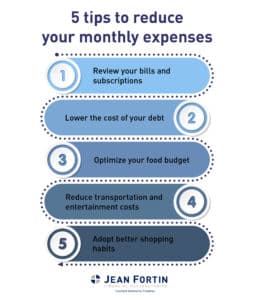
Review your bills and subscriptions
This is something we see far too often during our financial reviews: automatic payments can easily go unnoticed, even though they may add up to hundreds of dollars each year.
Take the time to review each of your recurring payments to:
- Compare your auto and home insurance policies to see whether you could qualify for a better premium.
- Reduce your electricity consumption by adopting simple habits, such as taking shorter showers, using appliances during off-peak hours, and optimizing your heating system.
- Contact your mobile phone or internet provider to negotiate your plan. There are promotions available, and the potential savings can be significant.
- Cancel subscriptions that you rarely or never use, whether they involve streaming services, apps, or a gym membership.
Lower the cost of your debts
When multiple debts accumulate, interest charges can quickly consume a significant portion of your budget.
If you have several balances to repay, focus your efforts on paying down the debts with the highest interest rates first, such as credit cards.
We also recommend avoiding minimum payments whenever possible. Making only the minimum payment significantly extends the repayment period and increases the total cost of the debt.
If your payments are becoming difficult to manage, debt consolidation may help simplify your finances by combining several debts into a single monthly payment. However, depending on your situation, other solutions that we can help you explore may be more appropriate.
Optimize your food budget
Groceries have been one of the fastest-growing expense categories in Quebec (approx 30% since 2020) in recent years and, for many households, represent the third-largest expense after housing and transportation. Fortunately, a few simple habits can help significantly reduce your grocery bill:
- Plan your meals for the week before shopping.
- Check flyers and build your menus around products that are on sale.
- Prepare lunches for work and cook larger portions that can be frozen for future meals. This strategy not only saves money but also saves time.
Even small savings made each week can add up to hundreds of dollars over the course of a year.
Reduce transportation and entertainment costs
Often overlooked, transportation expenses can sometimes be reduced without significant sacrifices. Whenever possible, consider using public transit or carpooling for certain trips.
If you use your vehicle less frequently than before, inform your insurance provider. A lower annual mileage may sometimes qualify you for reduced insurance premiums and meaningful savings.
For entertainment and leisure activities, we recommend setting a monthly amount that you are comfortable spending on restaurants, shows, and recreational activities. Including these expenses in your budget allows you to enjoy yourself while avoiding overspending.
Adopt better shopping habits
Impulse purchases are often responsible for a significant portion of unplanned expenses. But what exactly is an impulse purchase? It is a purchase made spontaneously without prior planning and, often, one that is not truly necessary. Examples include grabbing a snack at the checkout counter or making an online purchase after seeing a promotion without taking time to think it through. Individually, these purchases may seem harmless, but together they can represent a substantial amount of money.
Here are a few tips from our advisors and trustees to help you resist temptation:
- Before purchasing an item that was not planned, give yourself a 48-hour waiting period. In many cases, the urge passes and the purchase becomes unnecessary.
- Whenever you shop, prepare a list and stick to it.
- Do not hesitate to visit thrift stores or second-hand shops. You can often find clothing, furniture, and household items at a fraction of the cost of buying new.
These small behavioural changes can have a significant positive impact on your budget over time.
When cutting expenses is no longer enough
Reducing your expenses is an excellent way to regain control of your finances, but some situations go beyond budgeting alone. Job loss, separation, illness, reduced income, or mounting debt can make payments impossible to manage despite your best efforts.
At Jean Fortin & Associés, we regularly meet people who have already cut their expenses to the maximum without successfully restoring financial balance. In such situations, it may be necessary to consider a more appropriate solution.
Depending on your circumstances, several options may be available, including legal debt relief solutions such as a consumer proposal or bankruptcy, which can help you regain financial stability.
The important thing is to seek advice before the situation worsens. Our Licensed Insolvency Trustees take the time to review your financial situation and explain all the solutions available to you. The consultation is free, confidential, and comes with no obligation.
By Pierre Fortin
Jean Fortin & Associés
Personal Finance Advisor
Licensed Insolvency Trustee
When debt challenges become overwhelming, you don’t have to face them alone. Our advisors are ready to guide you (free, no-obligation consultation).
See also...
Loan Payment Calculator
Use the loan calculator to determine the monthly cost of a loan.
Online Budget
Create a budget to track your spending and successfully manage your financial priorities.
Does co-signing a loan for someone else affect my credit score?
Find out how your credit history could be affected if you agree to co-sign a loan for a family member or friend.