
How to pay off your debts fast?
In summary:
- Take inventory of your debts and choose a suitable repayment method (snowball or avalanche) while reducing your expenses and increasing your payments.
- Consolidate your debts to simplify repayments and look for additional income sources to pay off your debts faster.
- When your efforts are not enough, professional options exist to help you resolve your debts with solutions tailored to your situation.
In Canada, household debt has reached high levels, with a debt-to-income ratio of nearly 180% according to Statistics Canada. Consumer debts, such as credit cards, often carry interest rates above 20%, which can quickly slow down repayment and increase the total cost of borrowing.
In this context, adopting effective personal finance management and debt reduction strategies is essential to regain control and improve one’s financial health.
Our practical tips to get out of debts
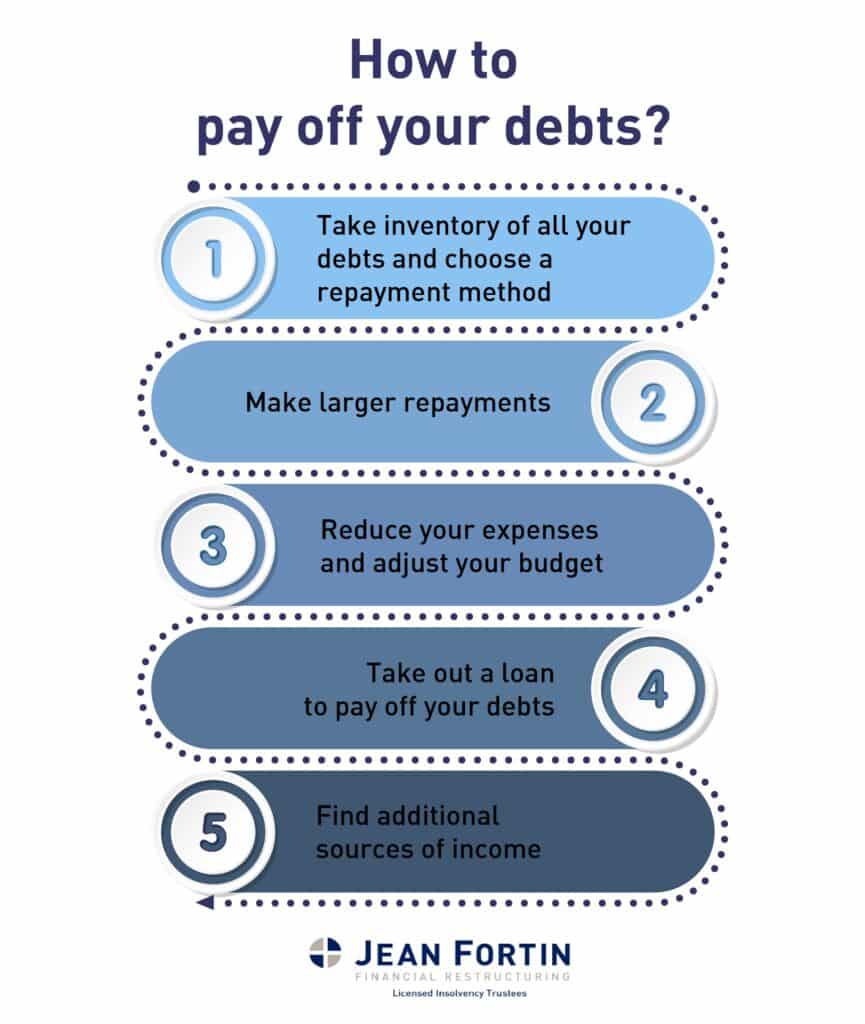
Paying off debt can seem overwhelming, but with the five effective strategies explained below, it is possible to speed up the process and improve your financial management. Here are our 5 tips to help you pay off your debts faster:
- Take inventory of all your debts and choose a repayment method
- Make larger payments
- Reduce your expenses
- Take out a loan to pay off your debts
- Find additional sources of income
Let’s explore each step of the bankruptcy process in detail together:
1. Take inventory of all your debts and choose a repayment method
The 1st tip to settle your debts more quickly is to gain a clear understanding of your situation by preparing a table listing all your debts, including the remaining balance, interest rate, and minimum monthly payment required for each. This will allow you to choose the repayment method best suited to your profile and motivation level:
a) Avalanche method: Identify the debts with the highest interest rates, typically credit cards, then focus your extra payments on those first while continuing to make minimum payments on the others. This approach reduces the total interest paid over the long term.
b) Snowball method: Start by paying off the debts with the smallest balances to achieve quick wins that boost your motivation. Eliminating a debt quickly creates a sense of accomplishment that encourages you to continue your efforts and maintain financial discipline.
2. Make larger payments
The 2nd strategy is simple but powerful: pay more than the minimum amount required, since minimum payments extend the repayment period and increase total interest costs. To do this, you can use your tax refunds, bonuses, overtime pay, or any unexpected money and apply it directly to your debt. Any extra amount will reduce interest charges and create a snowball effect.
For example, if your minimum payment is $75, try paying $100 or $125 instead. The additional amount could save you hundreds, or even thousands, of dollars in interest and shorten your repayment period by months or even years.
3. Reduce your expenses
Cutting certain non-essential expenses frees up extra cash to accelerate your repayments. Start by reviewing your bank statements from the last three months to identify areas where you can cut back. It’s also the perfect time to adjust your budget to better reflect reality.
For example, canceling a little-used $15 monthly subscription, reducing takeout from four times to once per week (saving about $200 per month), or negotiating your cell phone plan to save $20 monthly could easily free up $200, $300 per month, or more, to apply directly to your debts.
4. Take out a loan to pay off your debts
Another strategy is to combine your debts into a single loan, known as debt consolidation. The idea is to take out a loan at a lower interest rate (than your credit cards) to pay off those cards and other high-interest debts. This approach offers several advantages: one monthly payment that is easier to manage; a lower interest rate, meaning less interest paid and more going toward the principal; and a fixed, more predictable payment, making budgeting easier.
For example, if you have $15,000 spread across several cards at 19%, a consolidation loan at 12% could significantly reduce the interest paid. However, it is essential not to reuse the credit cards once consolidated to avoid increasing your total debt again.
5. Find additional sources of income
Increasing your income is often underestimated, yet even a few hundred extra dollars per month can significantly accelerate debt repayment. You could freelance in writing, graphic design, or tutoring; offer services such as cleaning, babysitting, or snow removal; sell unused items at home; or work a few extra hours at your job.
For example, if you generate an additional $300 per month and apply the entire amount to your debt, that represents $3,600 repaid in one year. However, this extra income should not fund new expenses, and you must also be mindful of burnout. This solution should be temporary to address a debt problem.
Additional tips to help you get rid of your debts faster
While eliminating one debt after another, make sure to:
- Stay up to date on all your debt payments to avoid damaging your credit rating.
- Avoid increasing the balance of your other debts: paying off one debt only makes sense if you do not increase others in the meantime.
- Avoid using your credit cards or “freeze” them: place your credit card(s) in a glass of water and put it in the freezer. If you suddenly feel the urge to use them, you’ll have a good 24 hours to think twice.
When eliminating debts is no longer enough, other solutions exist
Applying the snowball or avalanche methods requires some flexibility in your budget. But what should you do if, after cutting all possible expenses, your calculations still don’t balance? If you feel like you’re emptying the ocean with a teaspoon, it may be time to move to the next step. Solutions exist to lighten your financial burden if you are caught in a debt spiral. One of our Licensed Insolvency Trustees can offer you a free informational consultation to propose effective solutions tailored to help you get out of debt.
By Pierre Fortin
Jean Fortin & Associés
Personal Finance Advisor
Licensed Insolvency Trustee
When debt challenges become overwhelming, you don’t have to face them alone. Our advisors are ready to guide you (free, no-obligation consultation).
See also...
Debt Consolidation
Find out how to merge all your payments into one monthly installment and keep your credit score intact.
Quick Diagnosis
Get a quick diagnosis of your situation and find out more about your financial health.
Financial difficulties? Pay attention to the warning signs!
Be aware of the following signs to prevent financial difficulties.